
The Speed & Infrastructure Shift: Is Your Website Tech Holding Your Revenue Hostage?
By: Kushaagra Kapoor, Director of Technology, New Products and AI Implementation at Wxperts . 10-26-2026 | Reading Time: 7 mins
Traditional monolithic web stacks like legacy PHP and WordPress compromise small business revenue through runtime database drag, fragile plugin dependencies, and acute security vulnerabilities. Modern decoupled frameworks like Next.js eliminate server processing lag by pre-rendering pages straight to global edge networks. This infrastructure shift produces sub-second load times, conquers Google's Core Web Vitals, eliminates plugin vulnerabilities, and prepares your digital presence for autonomous AI answer engines.
Introduction: The Hidden Drag on Small Business Growth
If your small business website was built a few years ago using traditional platforms like PHP or WordPress, it might feel like it's doing its job just fine on the surface. For many of our clients, those earlier-generation builds served as a brilliant starting point, establishing an initial digital footprint when the demands of the web were vastly simpler.
However, beneath that familiar interface, a quiet shift in web technology is happening, and it might be quietly draining your bottom line.
In today's hyper-competitive digital economy, web performance isn't just a vanity metric reserved for massive enterprise tech corporations; it has become the ultimate survival tool for lean, growing businesses. Slow load times, heavy plugin dependencies, continuous security patches, and database drag do far more than frustrate your internal team. They create invisible friction that directly suppresses your daily inquiries, qualified phone calls, appointment bookings, and bottom-line revenue.
When a local customer or prospective client lands on your site, their decision to stay or bounce to a local competitor happens in under two seconds. Every extra millisecond your server spends compiling unoptimized database queries is a moment your customer spends walking away.
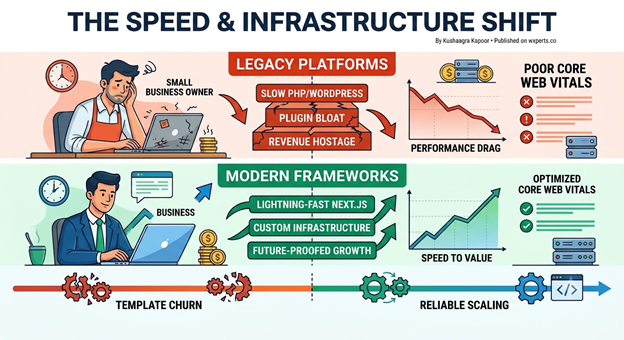
1. The Operational Friction of Legacy Platforms
To understand why older setups struggle to compete in the modern search and conversion landscape, it helps to examine how traditional monolithic platforms handle everyday user requests:
1 Server-Side Bottlenecks & Database Drag
Traditional PHP and WordPress installations generate pages dynamically on every single click. When a user visits your URL, the web server is forced to query the database, process layers of template logic, compile stylesheets, and stitch the entire HTML document together from scratch before sending a single byte back. Under mobile connections or sudden traffic spikes, this runtime pipeline stutters and chokes, inflating Time to First Byte (TTFB) into the multiple-second danger zone.
2 The Third-Party Plugin Trap
To compensate for missing platform functionality, small business sites typically accumulate between 20 to 45 third-party plugins for everyday features like contact forms, sliders, analytics, and basic SEO. Each plugin injects its own render-blocking JavaScript, unoptimized database queries, and styling files. The result is compounding technical debt, constant software conflicts, and endless maintenance babysitting just to prevent pages from breaking after weekly updates.
3 The Core Web Vitals Penalty
Search engines like Google evaluate websites rigorously on real-world user experience metrics: Largest Contentful Paint (LCP), Interaction to Next Paint (INP), and Cumulative Layout Shift (CLS). Monolithic templates routinely trigger layout shifts as asynchronous scripts load out of order. When your site stutters, search algorithms quietly demote your rankings, pushing your business beneath agile competitors where local buyers never see you.
Architecture Comparison: Legacy Monolith vs. Modern Edge Framework
When evaluating website infrastructure, the differences between monolithic CMS environments and custom-engineered edge frameworks affect every operational dimension of your business:
| Legacy Monolithic Stacks (PHP / WordPress) | Modern Decoupled Frameworks (Next.js / Jamstack) |
|---|---|
| Runtime Page Generation: Queries database, parses template files, and compiles HTML dynamically upon every visit. | Static & Edge Pre-Rendering: Pages are compiled ahead of time and served instantaneously from global edge Content Delivery Networks (CDNs). |
| Time to First Byte (TTFB): Typically 800ms to 2,500ms due to database overhead and heavy server processing. | Instantaneous TTFB: Sub-50ms globally; static assets hit the client browser with zero origin server delay. |
| Security Surface: Massive attack surface; exposed database credentials, SQL injection risks, and unpatched third-party plugins. | Decoupled Security: Frontend is completely severed from backend databases; no public database endpoint for malicious actors to attack. |
| Plugin Dependency: Dozens of third-party plugins requiring weekly updates, patching, and conflict resolution. | Zero Plugin Bloat: Lightweight custom-coded components and native libraries engineered specifically for your business needs. |
| Mobile Performance: Sluggish responsiveness, render-blocking scripts, and high mobile bounce rates. | App-Like Mobile UX: Ultra-fast page transitions, instant tactile response, and seamless mobile checkout/booking funnels. |
| Search & AI Readability: Bloated DOM trees, nested div wrappers, and slow crawl times that exhaust crawler token budgets. | Clean Semantic Data: Pure HTML5 markup paired with pre-rendered JSON-LD schema, perfectly optimized for LLMs and Answer Engines. |
2. The Modern Framework Alternative: Why Next.js Wins for Small Business
Modern web engineering resolves these legacy headaches by permanently decoupling your frontend presentation layer from backend databases. Instead of asking a single server to handle every visitor from scratch, modern frameworks like Next.js pre-compile content and distribute it across global edge networks, delivering lightning-fast speeds to every prospect.
By transitioning to modern frameworks like Next.js, small and growing businesses unlock enterprise-grade advantages without the enterprise price tag:
Instant Page Delivery
Pre-rendered static files and Incremental Static Regeneration (ISR) mean your website loads in under 300 milliseconds anywhere in the world, eliminating customer bounce before it begins.
Zero Plugin Bloat
Purpose-built, clean custom code replaces 30+ fragile plugins. Say goodbye to surprise site crashes caused by plugin incompatibility or developer abandonment.
Flawless Mobile UX
Because bloated libraries are eliminated, smartphone users enjoy an app-like, friction-free interaction that boosts click-to-call and lead conversion rates dramatically.
3. The Educational Core: Engineering for a Dual-Architecture Web
As consumer search habits rapidly evolve, your website cannot afford to be engineered solely for traditional Google blue-link search results. In 2026 and beyond, high-performing small business infrastructure must simultaneously serve two very different audiences:
Audience A: Human Buyers (UX & Conversions)
Human buyers are impatient, easily distracted, and highly sensitive to visual friction. When someone searches for an urgent service—whether an emergency dentist, a commercial contractor, or a boutique accounting firm—a site that lags or stutters immediately feels unorganized and untrustworthy. Sub-second speed and seamless layouts instill subconscious authority, keeping prospects engaged until they hit the call or booking button.
Audience B: Autonomous AI Agents & Answer Engines (AEO)
Today, your prospective clients are increasingly asking ChatGPT, Google Gemini, and Perplexity for local recommendations: "Find me the most reliable custom web development firm near Elk Grove." Autonomous AI agents do not wait for sluggish database queries to resolve, nor do they care about flashy animations. They look for clean, machine-readable, structured data.
By leveraging modern frameworks, your website serves pre-rendered, clean HTML alongside rich, embedded JSON-LD structured data schemas. This dual-architecture design guarantees human prospects enjoy a stunning, lightning-fast experience, while AI crawlers extract your business entities, service credentials, and verified answers with perfect precision.
4. The Recent PHP Security Crisis: Why Monolithic Stacks Are an Escalating Liability
Beyond speed and search optimization, recent systemic vulnerabilities and high-profile security exploits targeting PHP-based ecosystems and content management frameworks have underscored a harsh reality: monolithic infrastructure is increasingly fragile.
Monolithic applications that bundle database access, server-side processing, and third-party plugin execution into a single tightly-coupled environment create a massive, exposed attack surface. When a zero-day exploit or core dependency vulnerability hits the open web, small businesses relying on legacy setups are often left scrambling to patch systems, risking ransomware, customer data theft, catastrophic defacement, and severe damage to hard-earned reputation.
Transitioning to decoupled, static edge architecture permanently eliminates this vulnerability window. With no database directly connected to the public frontend and no executable PHP running on web requests, there is simply no server-side application layer for malicious bots to exploit.
5. Outlasting Template Churn: True Digital Infrastructure
For over a decade, the standard playbook for small businesses was simple: purchase a $50 commercial WordPress theme, install a handful of plugins, and hope for the best. Within eighteen months, plugins would start conflicting, the theme author would stop releasing updates, the layout would break on modern phone screens, and the business owner was forced to spend thousands of dollars to rebuild from scratch.
This endless, frustrating cycle is known as template churn.
Relying on off-the-shelf themes locks small businesses into perpetual rebuild debt. At Wxperts, we treat web design not as a disposable marketing brochure, but as foundational digital infrastructure. By custom-engineering high-performance web systems on modern frameworks, we remove third-party platform constraints permanently—giving small businesses an agile asset built to scale reliably for years to come.
Frequently Asked Questions
Why is website speed directly tied to small business revenue?
Studies consistently demonstrate that over 53% of mobile visitors abandon a website if it takes longer than 3 seconds to load. In local service markets, consumers make immediate trust assessments. Every extra millisecond of server latency directly reduces form fills, phone inquiries, and bookings while triggering search ranking demotions.
How does Next.js differ from traditional WordPress?
Traditional WordPress relies on dynamic runtime page generation—querying a database and executing PHP files for every page visit. Next.js decouples the frontend, pre-compiling pages into static, high-performance assets served instantaneously across worldwide edge networks with zero origin database lag.
Can a slow website hurt my rankings in AI answer engines?
Yes. Autonomous AI agents and LLM scrapers (like GPTBot and Perplexity) operate within strict latency and compute budgets. If a site takes multiple seconds to respond or hides critical business details behind bloated client-side scripts, AI engines bypass the site in favor of faster, machine-readable domains with structured JSON-LD schemas.
Why are decoupled websites significantly safer against cyber attacks?
In a decoupled architecture, your frontend files are hosted on edge servers without an active database connection or server-side PHP runtime. Because there is no public database endpoint or vulnerable plugin ecosystem, common vectors like SQL injection, cross-site scripting (XSS), and arbitrary code execution are virtually eliminated.
What does "outlasting template churn" mean for my company?
Template churn refers to the costly, recurring cycle of replacing fragile commercial themes every 2–3 years due to plugin breaks and abandoned code. Custom-engineered infrastructure provides clean, proprietary code that grows seamlessly alongside your business for the long term without obsolescence.
Semantic Keynotes & Named Entity Recognition (NER) Tags
1. Semantic Keynotes
- The Speed & Infrastructure Paradigm Shift: Analyzes the critical transition from legacy server-rendered CMS setups (PHP/WordPress) to modern edge-deployed decoupled frameworks (Next.js), framing web performance as an existential revenue survival tool for small and growing businesses rather than an enterprise luxury.
- The Triple Threat of Legacy Monolithic Architectures: Diagnoses the compounding operational friction in traditional stacks—specifically dynamic SQL database query latency, the compounding vulnerability and maintenance drag of 30+ third-party plugins, and algorithmic Core Web Vitals (LCP, INP, CLS) penalties.
- Decoupled Edge Engineering & Sub-Second Delivery: Explains how modern frameworks separate the frontend presentation layer from the database origin, pre-rendering static assets to global CDN edges for sub-50ms Time to First Byte (TTFB), zero plugin bloat, and frictionless mobile conversion funnels.
- Dual-Architecture Web for Humans and Autonomous AI Agents: Details the strategic necessity of engineering websites for both human decision-makers (demanding sub-2-second speed and visual trust) and conversational AI engines (ChatGPT, Google Gemini, Perplexity) through clean HTML5 and machine-readable JSON-LD entity graphs.
- The PHP Security Crisis & Attack Surface Elimination: Contextualizes recent systemic vulnerabilities and zero-day exploits in monolithic PHP/CMS environments, illustrating how static edge deployment permanently removes executable server code and public database endpoints.
- Outlasting Template Churn via Custom Infrastructure: Replaces the disposable commercial theme cycle with custom-coded, durable web architecture engineered to scale reliably without recurring rebuild costs.
2. Named Entity Recognition (NER) Tags
- ORGANIZATION & BRAND ENTITIES (ORG):
- Wxperts Inc, Wxperts Co
- PERSON & TECHNICAL LEADERSHIP (PER):
- Kushaagra Kapoor (Director of Technology, New Products and AI Implementation at Wxperts)
- FRAMEWORKS, PROGRAMMING LANGUAGES & PLATFORMS (TECH / PLATFORM):
- Next.js, React.js, PHP, WordPress, Jamstack, Node.js, Content Delivery Networks (CDNs), Edge Compute Networks, SQL Databases
- AI ENGINES, LLMS & CRAWLERS (AI / SEARCH):
- Large Language Models (LLMs), OpenAI ChatGPT, Google Gemini, Perplexity AI, ClaudeBot, GPTBot, Google AI Overviews
- PERFORMANCE, METRICS & ARCHITECTURAL CONCEPTS (CONCEPT):
- Core Web Vitals, Largest Contentful Paint (LCP), Interaction to Next Paint (INP), Cumulative Layout Shift (CLS), Time to First Byte (TTFB), Static Site Generation (SSG), Incremental Static Regeneration (ISR), Decoupled Architecture, Monolithic Stacks, Template Churn, Conversion Rate Optimization (CRO), Plugin Bloat, Digital Infrastructure
- TECHNICAL AEO, GEO & CODE ENTITIES (TECH / SPEC):
- Answer Engine Optimization (AEO), Generative Engine Optimization (GEO), Named Entity Recognition (NER) Tags, JSON-LD Structured Data Schema, BlogPosting Schema, FAQPage Schema, Semantic HTML5 Markup
- TARGET AUDIENCE & GEOGRAPHIC SCOPE (GEO_LOC):
- 1,100+ Small and Medium Businesses (SMBs), United States, Canada, United Kingdom, Elk Grove CA
- COMMUNICATION & VERIFICATION CHANNELS (CONTACT):
- Toll Free: (855) 469-6368, (888) 487-3122 | Direct: (279) 348-2227 | Email: contact@wxperts.co