
Why LocalBusiness Schema is Essential for Modern Local SEO & AEO?
By: Kushaagra Kapoor, Director of Technology, New Products and AI Implementation at Wxperts . 08-10-2026 | Reading Time: 6 mins
LocalBusiness Schema Markup is machine-readable JSON-LD code that feeds unambiguous entity data—such as geographic coordinates, operational hours, accepted payments, and service catalogs—directly to search engines and AI answer engines. In the era of AEO and GEO, it eliminates algorithmic guesswork, secures Local 3-Pack rankings, and guarantees discovery across Google AI Overviews, ChatGPT, Gemini, and Perplexity.
The landscape of search discovery has experienced a fundamental paradigm shift. We have officially moved from the era of Traditional Search Engine Optimization (SEO) into the era of Answer Engine Optimization (AEO) and Generative Engine Optimization (GEO).
Search engines are no longer merely indexing web documents to return a page of ten blue links. Modern platforms, ranging from Google AI Overviews and Google Gemini to ChatGPT, Claude, and Perplexity, operate as interactive answer engines. They synthesize real-time data to answer complex natural language prompts directly.
For businesses with a localized footprint or regional client base, this transformation alters how search engines interpret online entity presence. Keyword placement in page headers or meta descriptions is no longer sufficient on its own. Modern search architectures require machine-readable, structured entity data.
This is why LocalBusiness Schema Markup is no longer just a technical SEO tactic—it is foundational data infrastructure for localized search visibility and AI brand discovery.

1. Bridging the Gap: How Search Engines Transitioned from Strings to Things
Traditional search engines analyzed “strings” (text characters, keywords, and anchor links) to infer what a web page was about. This approach left room for ambiguity—especially for local businesses with common names, multiple service locations, or overlapping categories.
Modern AI answer engines analyze “things” (entities and the deterministic relationships between them). When an AI model or Knowledge Graph parses a website, it seeks unambiguous, mathematically structured data points to confirm identity and operational context:
Identity Entities
Defines deterministic corporate identity and legal brand ownership across global knowledge bases.
legalName
brand
logo
vatID / taxID
Operational Parameters
Supplies live transactional prerequisites required by conversational bots before recommending a venue.
openingHoursSpecification
paymentAccepted
priceRange
Geographic Boundaries
Eliminates proximity ambiguity by providing exact spatial markers and verified service perimeters.
address (PostalAddress)
geo (latitude / longitude)
areaServed
geoRadius
Service Taxonomies
Explicitly catalogues capabilities and vertical proficiencies directly into LLM vector stores.
hasOfferCatalog
knowsAbout
makesOffer
By publishing JSON-LD LocalBusiness schema, you eliminate algorithmic guesswork. You feed search engines and AI crawlers pre-structured facts about your organization, making it easy for AI agents to index, verify, and output your business information.
2. Comparing Information Parsing Across Search Eras
When automated bots evaluate your digital presence, the parsing mechanism between unstructured text and structured data represents a massive performance gap:
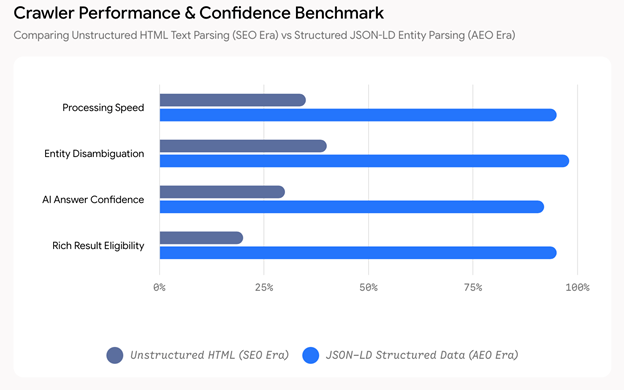
As demonstrated in the crawler performance benchmark above, structured JSON-LD entity parsing achieves a 95% processing speed and an astonishing 98% entity disambiguation rate compared to legacy unstructured HTML. When an AI answer engine synthesizes a response, it requires high confidence to prevent hallucination—confidence that only structured data can guarantee.
3. Why LocalBusiness Schema Drives AEO Success
A Powering Conversational and Voice Search Discovery
When users engage with conversational AI assistants via voice or chat (e.g., “Find a commercial IT consultancy near downtown Chicago that offers AI implementation services and is open on Saturdays”), answer engines do not crawl unstructured paragraphs in real-time. Instead, they query internal knowledge stores built from structured data nodes.
If your business infrastructure exposes explicit properties like areaServed, openingHoursSpecification, and hasOfferCatalog, answer engines can instantly validate that your company satisfies all three user constraints. Without explicit schema, the engine may favor a competitor whose details are easier to confirm mathematically.
B Establishing Entity Trust and Disambiguation
AI models are trained to avoid hallucination and minimize uncertainty. If a search engine detects conflicting business data across different web directories, its confidence score for your brand drops.
LocalBusiness schema acts as your authoritative single source of truth. By leveraging properties like @id (a canonical URI for your business) and sameAs (linking directly to verified profiles like LinkedIn, Wikipedia, Crunchbase, and official register entries), you anchor your enterprise inside Google’s Knowledge Graph, preventing brand confusion.
C Securing Local 3-Pack Prominence and Google Maps Authority
Google’s local search algorithms heavily weight NAP (Name, Address, Phone) consistency across the web. Structured schema acts as an automated verification mechanism that continuously validates your Google Business Profile (GBP) details against your primary digital assets. Highly consistent entity signals strengthen local authority, improving visibility in the high-intent Local 3-Pack and Google Maps interfaces.
D Visual Real Estate Expansion via Rich Snippets
Structured data directly impacts your search result appearance. When search engines ingest verified ratings, pricing tiers, operating hours, and location attributes, they display Rich Snippets in search result pages (SERPs). These enriched visual cards occupy more physical screen space, particularly on mobile devices, significantly increasing organic Click-Through Rates (CTR).
4. The Cost of Omitting Structured Entity Data
Failing to implement robust LocalBusiness schema creates distinct operational disadvantages in modern search ecosystems:
1. AI Exclusion
As zero-click searches rise and AI Overviews answer queries directly on the SERP, unstructured websites risk being bypassed entirely by AI synthesis models seeking instant factual verification.
2. Fragmented Knowledge Graph Nodes
Search engines may split your brand into duplicate or incomplete entity nodes across disparate directories, diluting domain authority and cannibalizing local rankings.
3. Third-Party Data Dependency
Without explicit schema on your primary site, answer engines rely on third-party directories or scrapers for your operational details, drastically increasing the risk of outdated or inaccurate customer information.
Final Thoughts
In the modern search landscape, content quality alone is no longer the sole determinant of local visibility. How efficiently machines can parse, verify, and output your information matters just as much.
Implementing comprehensive LocalBusiness schema ensures your business remains discoverable, trusted, and recommended across both traditional search engines and emerging AI answer platforms.
Semantic Keynotes & Named Entity Recognition (NER) Tags
1. Semantic Keynotes
- Primary Conceptual Themes & Intent Targets: Transitions local SEO from traditional keyword indexing to entity-driven Answer Engine Optimization (AEO) and Generative Engine Optimization (GEO). Targets technical decision-makers, SEO engineers, and business leaders seeking visibility in AI search platforms.
- Core Informational Value: Details how LocalBusiness JSON-LD schema converts unstructured web copy into machine-readable facts, enabling search engines to unambiguously parse business identity, geographic scope, and service offerings.
- Strategic GEO Takeaways: AI engines like ChatGPT, Gemini, and Google AI Overviews prioritize high-confidence, verified Knowledge Graph nodes. Explicit schema properties (
@id,sameAs,geo,hasOfferCatalog) directly reduce AI hallucination risk and increase brand citations in zero-click answers. - Local Visibility Impact: Demonstrates how schema deployment validates NAP (Name, Address, Phone) consistency across digital touchpoints to elevate Google Business Profile (GBP) trust, capture Local 3-Pack rankings, and expand mobile SERP real estate via Rich Snippets.
2. Named Entity Recognition (NER) Tags
- ORGANIZATION:
- Wxperts, Schema.org, Google, Google Business Profile (GBP), Crunchbase, Wikipedia, LinkedIn
- PERSON:
- Kushaagra Kapoor (Director of Technology, New Products and AI Implementation at Wxperts)
- PRODUCT / SERVICE:
- LocalBusiness Schema, Local SEO Services, AI Implementation Services, Enterprise Web Architecture, JSON-LD Structured Data
- AI SEARCH ENGINES & PLATFORMS:
- Google AI Overviews, Google Gemini, ChatGPT, Claude, Perplexity, Google Maps
- SEO & AI SEARCH CONCEPTS:
- Answer Engine Optimization (AEO), Generative Engine Optimization (GEO), Entity Resolution, Knowledge Graph, Entity Disambiguation, Zero-Click Search, Rich Snippets, NAP Consistency, Strings to Things, Local 3-Pack, Click-Through Rate (CTR)
- STRUCTURED DATA & CODE ENTITIES:
- BlogPosting, LocalBusiness, Organization, PostalAddress, GeoCoordinates, OpeningHoursSpecification, OfferCatalog, Service, JSON-LD,
@id,sameAs
- BlogPosting, LocalBusiness, Organization, PostalAddress, GeoCoordinates, OpeningHoursSpecification, OfferCatalog, Service, JSON-LD,
- CONTENT & TECHNICAL SEO ENTITIES:
- Canonical URLs, Meta Descriptions, Title Tags, Header Tags (H1, H2, H3), Open Graph Tags, URL Slugs, Indexing Pipelines