
Mastering Canonical Brand Authority: Why High-Performing Sites Lead and Others Fall Behind?
By: Kushaagra Kapoor, Director of Technology, New Products and AI Implementation at Wxperts – 08-10-2026 | Reading Time: 7 mins
Canonical Brand Authority is the machine-readable technical foundation enabling search engines and AI crawlers to uniquely identify and validate a business within global Entity Graphs. High-performing sites secure top visibility by enforcing strict NAP+U alignment, optimizing DOM render velocity, and deploying explicit, declarative JSON-LD schema grounding.
Canonical Brand Authority: High-Performing Sites vs. Low-Visibility Domains
In the modern digital landscape, search engines and AI engines no longer read websites purely as collections of keywords and web pages. Instead, they interpret the web through Entity Graphs—interconnected networks of real-world brands, locations, organizations, and experts.
Top-rated sites (scoring A and A+ in visibility and trust metrics) secure their position because they establish Canonical Brand Authority. They don't just ask search engines and AI agents (like GPTBot, PerplexityBot, and Google-Extended) to guess who they are—they give them clear, high-velocity, structured proof.
Conversely, low-visibility sites often struggle because they lack these technical foundations. Below is a breakdown of the three critical pillars that separate industry leaders from lagging domains, and the real-world consequences of missing them.
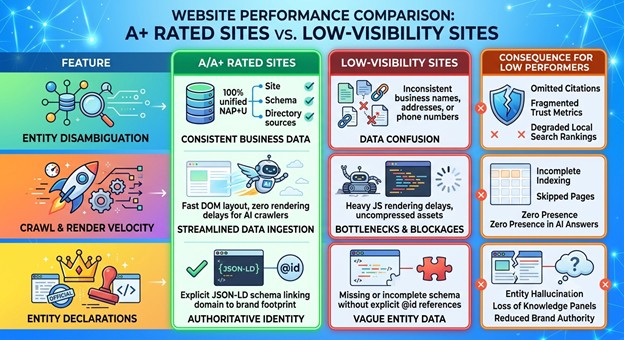
The 3 Pillars of Canonical Brand Authority
Entity Disambiguation (NAP+U Alignment)
Entity disambiguation is the process of helping search engines and LLM web crawlers uniquely identify your organization without confusion or overlap with similarly named entities.
How High-Performing Sites Win
Top-rated domains enforce strict consistency across their NAP+U (Legal Name, Address, Telephone, and URL). Whether an AI scraper evaluates the site’s structured data, its Google Business Profile, local directory listings (Yelp, BBB), or official registries, the core identity vectors match down to the exact punctuation.
How Low-Visibility Sites Fail
Lower-performing sites suffer from entity dilution. They use mismatched business names across directories (e.g., "Wxperts Inc." on one page vs. "Wxperts Technologies" on another), inconsistent local numbers, or conflicting suite addresses.
The Consequences
- Loss of Citation Trust: AI synthesis engines (like Perplexity or ChatGPT with Search) hesitate to cite sources with ambiguous identity data.
- Split Authority: The site's trust metrics get fragmented across duplicate or unlinked entity entries, severely degrading rankings in local and organic search.
Crawl & Render Velocity for AI Scraping
With AI search models consuming vast amounts of real-time web content, your site’s rendering efficiency directly impacts how effectively bots can ingest your knowledge.
How High-Performing Sites Win
A-grade sites optimize for immediate DOM parsing. By maintaining a lightweight DOM structure, compressing assets, and minimizing JavaScript rendering delays, they ensure that AI crawlers, such as GPTBot, PerplexityBot, and Google-Extended, can parse the full, unrendered HTML text instantly on a single HTTP request.
How Low-Visibility Sites Fail
Lagging domains rely heavily on heavy client-side JavaScript rendering, bloated frameworks, and unoptimized multi-megabyte payloads. When an AI bot hits a paywall of deferred JS execution or dynamic DOM generation, it often times out or misses crucial content.
The Consequences
- Incomplete Indexing: AI models extract partial or outdated content, leading to missing attributes in AI answers and search snippets.
- Ignored Content: Search crawlers enforce strict budget limits on rendering time. High-latency client-side rendering leads directly to missed pages and lower overall search coverage.
Declarative Entity Declarations (JSON-LD Grounding)
Proving brand identity requires authoritative, explicit declarations in your code, rather than leaving search engines to infer facts from paragraph text.
How High-Performing Sites Win
Leading sites deploy explicit, machine-readable declarations through dedicated about.jsonld files or direct homepage schema blocks (@type: Organization or @type: Brand). They explicitly assert their official domain node, social handles (sameAs), and exact geographic footprint directly in structured JSON-LD.
How Low-Visibility Sites Fail
Lower-ranked sites omit structured data entirely or rely on basic, auto-generated meta tags that lack entity identifiers (@id). They provide no direct link between their domain node and their digital footprint across authoritative third-party platforms.
The Consequences
- Entity Confusion: AI tools may misattribute your brand's achievements, products, or reviews to a competitor with a similar name.
- Reduced Search Feature Eligibility: Without structured organization and brand nodes, websites lose access to Knowledge Panels, rich snippets, and direct brand grounding in conversational search experiences.
Key Takeaway for Engineering & Marketing Teams
Building brand authority today extends far beyond traditional backlink outreach and keyword optimization. It requires machine-readable clarity. By establishing clean entity disambiguation, rapid render speeds for AI scrapers, and explicit JSON-LD schema grounding, your brand establishes itself as the definitive, undeniable canonical source in your industry.
How We at Wxperts Bridge the Brand Authority Gap?
Establishing canonical brand authority isn't just about technical tweaks—it requires a holistic engineering and architectural approach. At Wxperts, we specialize in transforming low-visibility domains into enterprise-grade digital entities that search engines and AI agents trust implicitly.
Our AI Implementation and Engineering teams work directly with your stack to:
- Unify Entity Architecture: We conduct end-to-end NAP+U audits, resolving data fragmentation across web properties, directories, and third-party entity graphs to build a single source of truth for your brand.
- Optimize Crawl & Render Velocity: We streamline DOM structures, eliminate client-side JavaScript rendering delays, and build lightweight, high-speed delivery layers so AI scrapers and search bots instantly process your full text on a single pass.
- Deploy Advanced JSON-LD Schemas: We design and implement custom, explicit schema architectures (including dedicated
@idbrand nodes andabout.jsonldfootprints) that protect your brand from LLM hallucination and secure prominent Knowledge Panel placement.
Semantic Keynotes & Named Entity Recognition (NER) Tags
1. Semantic Keynotes
- Core Conceptual Framework: Defines Canonical Brand Authority as the essential technical foundation for aligning business identity within AI-driven Entity Graphs and Large Language Model (LLM) index architectures.
- Performance Differentiation: Identifies three specific technical pillars—NAP+U alignment, DOM render velocity, and JSON-LD schema grounding—that distinguish high-visibility market leaders from low-performing domains.
- AI Search Alignment: Focuses on the transition from keyword-based search to Entity-based interpretation, emphasizing that LLM scrapers prioritize machine-readable, unambiguous proofs of existence.
- Strategic GEO Outcomes: Provides actionable paths for engineering and marketing teams to mitigate LLM hallucinations and ensure consistent Knowledge Panel eligibility through declarative identity assertions.
2. Named Entity Recognition (NER) Tags
- ORGANIZATION:
- Wxperts, Yelp, BBB (Better Business Bureau), LinkedIn, Google Business Profile
- PERSON:
- Kushaagra Kapoor (Director of Technology, New Products and AI Implementation at Wxperts)
- AI CRAWLERS & LLM BOTS:
- GPTBot, PerplexityBot, Google-Extended, ChatGPT, Perplexity AI, Google AI Overviews
- CORE CONCEPTS:
- Canonical Brand Authority, Entity Disambiguation, NAP+U Alignment, Crawl & Render Velocity, Declarative Entity Declarations, JSON-LD Schema Grounding, Entity Graphs, Knowledge Panels