
The Local Footprint Vulnerability Check
By: Kushaagra Kapoor, Director of Technology, New Products and AI Implementation. 11-17-2026 | Reading Time: 6 mins
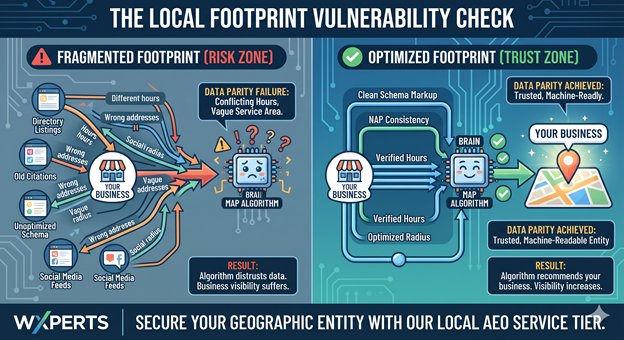
When map applications, voice assistants, and AI answer engines receive conflicting operational signals, such as misaligned hours, vague service radii, or fragmented directory data, they experience data verification failure. To protect users from bad recommendations, these systems automatically bypass your local entity and default to recommending competitors with clean, synchronized geographic profiles.
Is Your Local Business Setup Confusing Google and AI Maps?
If you manage a localized service business, a medical practice, a multi-location franchise, or a professional agency, you have likely run this experiment: you pull up Siri, Google Maps, or an AI-powered search tool on your phone, ask for the top provider in your exact sector, and watch your biggest local competitor capture the recommendation—even when your storefront or service footprint is closer.
You check your dashboard. Your core Google Business Profile looks complete enough. You have reviews, photos, and a physical address. So why are AI discovery engines and map algorithms quietly filtering you out of top-tier local placement?
The answer lies in a hidden modern oversight: fragmented geographic entity mapping.
The Anatomy of Local Disconnection
Traditional local SEO used to be a game of volume: stuffing local keywords into landing page titles, building generic directory backlinks, and hoping proximity would carry the day.
Today’s discovery ecosystem is entirely different. Voice assistants (Siri, Alexa, Google Assistant) and generative search algorithms (Perplexity, ChatGPT, Gemini, and Google AI Overviews) do not just "crawl keywords"—they assemble unified entities. They cross-reference your business identity across dozens of independent data sources: map directories, data aggregators, local citations, structured schema markup on your website, and unstructured review text.
When these systems evaluate your local footprint, they look for absolute data parity. But most local businesses suffer from structural data decay:
Conflicting Directory Citations: Your old suite number, former phone number, or slightly altered business name still lives on legacy directory listings, Yelp variants, and niche yellow pages. Automated AI agents cross-check these records and flag discrepancies as verification risks.
Unoptimized Service-Area Configurations: If you operate as a hybrid business (serving customers both at a location and across a geographic radius), vague or overlapping service-area polygons confuse mapping engines trying to calculate travel times and service relevancy.
Operational Hour Discrepancies: Holiday hours, seasonal closing shifts, or temporary changes updated on Facebook but missing from your primary structured schema create conflicting signals that automated crawlers flag as unverified.
The Local Footprint Vulnerability Matrix
The following table illustrates the structural difference between a fragmented local footprint in the risk zone versus an optimized entity in the trust zone:
| Entity Component | Fragmented Footprint (Risk Zone) | Optimized Footprint (Trust Zone) |
|---|---|---|
| Directory & NAP Listings | Conflicting addresses, old phone numbers, mismatched suite numbers | 100% harmonized NAP+W across all tier-one citations and data aggregators |
| Service-Area Boundaries | Vague, overlapping polygons confusing travel time engines | Machine-parsable GeoCoordinates and precise geographic boundary mapping |
| Operational Hours | Mismatches across holiday/seasonal hours and social feeds | Synchronized structured schema with real-time verified operational hours |
| Schema Markup Status | Unstructured web text or missing LocalBusiness schema | Injected JSON-LD @graph schema with deep entity identity markers |
| Algorithm Action & Result | Data verification failure; AI defaults to competitor | Zero ambiguity achieved; algorithm recommends your business as primary local answer |
Why AI Maps Default to Your Competitors
Large Language Models and vector-based mapping engines operate under a strict core directive: risk mitigation.
When an AI assistant recommends a business to a user, it puts its credibility on the line. If a user drives to a closed location or calls a disconnected phone number because of bad data, the AI engine loses trust.
Therefore, when algorithms encounter conflicting operational signals about your operating hours, service radius, or exact service offerings, they do not guess—they default to recommending competitors.
If your digital footprint is messy, fragmented, or ambiguous, the algorithm views your business as a high-friction entity. It steps back and hands the placement to a competitor whose data is clean, structured, and machine-readable.
The Local AEO Fix: Securing Your Geographic Entity
Fixing local visibility in the age of AI requires moving beyond basic directory updates. You need a rigorous technical audit of your local entity infrastructure:
Structured Schema Synchronization: Embed precise LocalBusiness and GeoCoordinates JSON-LD schema markup directly into your website’s source code, ensuring machine-to-machine clarity for crawlers.
NAP+W Consistency Audits: Harmonize Name, Address, Phone Number, and Website parameters across every tier-one citation source and data aggregator to establish complete data parity.
Service-Radius Optimization: Replace ambiguous regional descriptions with precise, machine-parsable geographic boundaries and localized landing page architectures.
Clean Up Your Geographic Entity Mapping with Wxperts
You shouldn't have to guess whether AI maps and voice search engines understand your local footprint.
At Wxperts, our specialized Answer Engine Optimization (AEO) service tier is engineered specifically to eliminate data fragmentation, build airtight machine-readable schemas, and anchor your business data as trusted fact across every major AI discovery engine.
Frequently Asked Questions
What causes a local footprint vulnerability?
A local footprint vulnerability is caused by fragmented and conflicting data across the web—such as varying operational hours, outdated telephone numbers, missing suite numbers, or vague service area descriptions that confuse AI mapping algorithms.
Why does data parity matter to voice assistants like Siri and Google Assistant?
Voice assistants must deliver a single, definitive answer with absolute accuracy. When data parity is lacking across citations and schema, the assistant risks giving out incorrect hours or disconnected numbers. To eliminate that risk, it bypasses unverified listings entirely.
How does LocalBusiness JSON-LD schema help?
LocalBusiness schema provides machine-readable code embedded directly in your website that explicitly defines your business name, coordinates, service area, hours, and contact details, giving search crawlers verified facts with zero ambiguity.
How can Wxperts help fix my local entity footprint?
Through our AI Search Accelerator and Local AEO service tiers, we audit your citation footprint, harmonize your NAP+W across aggregators, and code precise structured schemas that establish your business as the default recommendation in your area.
Semantic Keynotes & Named Entity Recognition (NER) Tags
1. Semantic Keynotes
- The Local Footprint Vulnerability Dilemma: Analyzes why local businesses with complete Google Business profiles still get bypassed by conversational AI tools and smart maps due to data verification failures.
- The Risk Mitigation Imperative in AI Search: Explains how LLMs and vector mapping engines prioritize data certainty, defaulting to competitors when encountering conflicting operating hours or vague service boundaries.
- Data Parity & The Anatomy of Local Disconnection: Identifies the three primary vectors of data decay: conflicting directory citations, unoptimized hybrid service-area polygons, and operational hour discrepancies.
- The Three Pillars of Local AEO Optimization: Details technical remedies: structured LocalBusiness and GeoCoordinates JSON-LD schemas, comprehensive NAP+W consistency audits, and machine-parsable boundary configurations.
- Wxperts Local AEO Framework: Connects technical schema engineering with multi-aggregator synchronization to turn local businesses into default recommendations across Siri, Google Maps, Gemini, and ChatGPT.
2. Named Entity Recognition (NER) Tags
- ORGANIZATION & BRAND ENTITIES (ORG):
- Wxperts, wxperts.co
- PERSON & TECHNICAL LEADERSHIP (PER):
- Kushaagra Kapoor (Director of Technology, New Products and AI Implementation)
- AI PLATFORMS, VOICE ASSISTANTS & MAPS (TECH / PLATFORM):
- Google Maps, Apple Maps, Siri, Alexa, Google Assistant, OpenAI ChatGPT, Google Gemini, Perplexity AI, Google AI Overviews
- TECHNICAL SCHEMAS & DATA STANDARDS (TECH / SPEC):
- Local AEO, Answer Engine Optimization (AEO), LocalBusiness Schema, GeoCoordinates Schema, JSON-LD @graph, NAP+W Consistency, Data Parity, Geographic Polygon Boundaries
- LOCAL BUSINESS TYPES & GEOGRAPHY (GEO_LOC):
- Local Service Businesses, Medical Practices, Multi-Location Franchises, Professional Agencies, Elk Grove CA, United States
- COMMUNICATION & VERIFICATION CHANNELS (CONTACT):
- Toll Free: (888) 487-3122, (855) 469-6368 | Direct: (279) 348-2227 | Email: contact@wxperts.co