
Flat Schema Fails in AI Search: How JSON-LD @graph Connects Your Brand Entities
By: Kushaagra Kapoor, Director of Technology, New Products and AI Implementation at Wxperts · Date: 11-26-2026 | Reading Time: 5 mins | Category: Answer Engine Optimization (AEO) & Technical Infrastructure
Flat schema places isolated, disconnected JSON-LD blocks on a webpage, forcing search engines and AI answer engines (like Google AI Overviews, ChatGPT, Gemini, Claude and Perplexity) to guess how your organization, services, authors, and webpages relate to one another. A JSON-LD @graph schema consolidates all page entities into a single unified array and links them deterministically using @id URI references—turning scattered metadata into a verified, machine-readable Knowledge Graph node that eliminates AI hallucination and increases brand citations.
1. The Hidden Flaw in Traditional “Flat” Schema
Most websites implement structured data using plugins or standalone scripts that inject separate <script type="application/ld+json"> tags onto a page—one for Organization, another for WebPage, another for Article or Service, and another for FAQPage.
While these isolated blocks may pass basic Rich Results validation tests, they create fragmented entity nodes:
No Deterministic Relationships
When Article and LocalBusiness sit in separate script tags without cross-referencing @id pointers, an LLM or crawler sees two unrelated facts rather than “This authoritative service page is published by this verified local business.”
Entity Duplication & Dilution
Repeating company names, addresses, and logos across multiple disconnected blocks forces crawlers to reconcile whether those blocks refer to the exact same legal entity or separate branches.
High Ambiguity in Generative Synthesis
Answer engines rely on confidence thresholds before citing a brand in zero-click responses. When entity ownership, authorship, and service offerings aren't explicitly wired together, AI models default to competitors whose entity graphs are easier to verify.
2. Flat Schema vs. Connected JSON-LD @graph Architecture
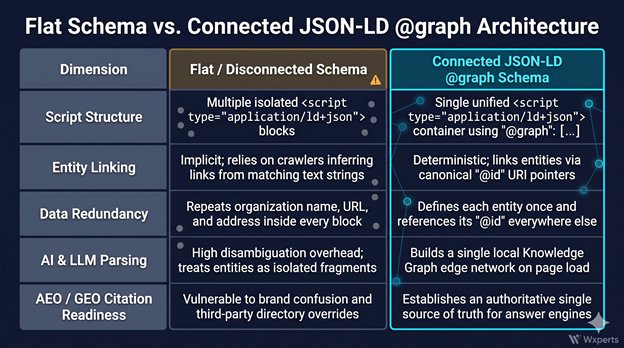
| Dimension | Flat / Disconnected Schema | Connected JSON-LD @graph Schema |
|---|---|---|
| Script Structure | Multiple isolated <script type="application/ld+json"> blocks |
Single unified <script type="application/ld+json"> container using "@graph": [...] |
| Entity Linking | Implicit; relies on crawlers inferring links from matching text strings | Deterministic; links entities via canonical "@id" URI pointers |
| Data Redundancy | Repeats organization name, URL, and address inside every block | Defines each entity once and references its "@id" everywhere else |
| AI & LLM Parsing | High disambiguation overhead; treats entities as isolated fragments | Builds a single local Knowledge Graph edge network on page load |
| AEO / GEO Citation Readiness | Vulnerable to brand confusion and third-party directory overrides | Establishes an authoritative single source of truth for answer engines |
3. How JSON-LD @graph Works Under the Hood
Instead of declaring a single @type at the root of your JSON-LD payload, @graph opens an array of distinct entity objects under one shared @context. Each entity is assigned a permanent, hash-anchored URI via @id (for example, https://www.wxperts.co/#organization), allowing other nodes in the graph to point directly to it.
Core Nodes in an AEO-Ready @graph:
- Organization / LocalBusiness (/#organization): Anchors your legal name, physical address, coordinates (geo), contact points,
hasOfferCatalog, and external verification profiles (sameAslinks to LinkedIn, Crunchbase, and Google Business Profile). - WebSite (/#website): Declares the domain's canonical identity and links
"publisher": { "@id": "https://www.wxperts.co/#organization" }. - WebPage (/#webpage): Connects the specific URL to both the parent site (
isPartOf) and the primary business entity (aboutormainEntity). - Service or BlogPosting (/#service / /#article): Links
"provider"or"author"directly back to your verified Organization and Person@idnodes rather than retyping plain-text strings.
4. Production Example: Connected JSON-LD @graph
Below is how a service page connects Organization, WebSite, WebPage, and Service into a single machine-readable entity graph:
{
  "@context": "https://schema.org",
  "@graph": [
    {
      "@type": "ProfessionalService",
      "@id": "https://www.wxperts.co/#organization",
      "name": "Wxperts",
      "url": "https://www.wxperts.co/",
      "logo": {
        "@type": "ImageObject",
        "@id": "https://www.wxperts.co/#logo",
        "url": "https://www.wxperts.co/assets/logo.png"
      },
      "address": {
        "@type": "PostalAddress",
        "streetAddress": "10324 Tempo Way",
        "addressLocality": "Elk Grove",
        "addressRegion": "CA",
        "postalCode": "95757",
        "addressCountry": "US"
      },
      "sameAs": [
        "https://www.linkedin.com/company/wxperts"
      ]
    },
    {
      "@type": "WebSite",
      "@id": "https://www.wxperts.co/#website",
      "url": "https://www.wxperts.co/",
      "name": "Wxperts",
      "publisher": {
        "@id": "https://www.wxperts.co/#organization"
      }
    },
    {
      "@type": "WebPage",
      "@id": "https://www.wxperts.co/the-ai-search-accelerator-package.php#webpage",
      "url": "https://www.wxperts.co/the-ai-search-accelerator-package.php",
      "name": "The AI Search Accelerator Package | Wxperts",
      "isPartOf": {
        "@id": "https://www.wxperts.co/#website"
      },
      "about": {
        "@id": "https://www.wxperts.co/#organization"
      },
      "mainEntity": {
        "@id": "https://www.wxperts.co/the-ai-search-accelerator-package.php#service"
      }
    },
    {
      "@type": "Service",
      "@id": "https://www.wxperts.co/the-ai-search-accelerator-package.php#service",
      "name": "The AI Search Accelerator Package",
      "serviceType": "AI Search Optimization & Digital Infrastructure",
      "provider": {
        "@id": "https://www.wxperts.co/#organization"
      },
      "areaServed": {
        "@type": "Country",
        "name": "United States"
      }
    }
  ]
}
5. How @graph Directly Impacts AEO and GEO Visibility
Eliminates Entity Hallucination
When an AI engine parses your page, every claim—who built the site, who wrote the article, which company provides the service, and where they operate—resolves to a single verified @id.
Strengthens E-E-A-T Signals for LLMs
Connecting Person nodes (with jobTitle, knowsAbout, and sameAs credentials) to BlogPosting and Organization nodes gives generative engines verifiable proof of human authorship and domain expertise.
Scales Cleanly Across Templates
Because your global @graph (Organization + WebSite) stays consistent across every URL while page-specific nodes (WebPage, Service, BlogPosting, FAQPage) plug into the same @id anchors, your entire domain functions as a cohesive knowledge base rather than a collection of disconnected pages.
Semantic Keynotes & Named Entity Recognition (NER) Tags
1. Semantic Keynotes
- Primary Conceptual Themes & Intent Targets: Explains the technical limitations of flat, disconnected JSON-LD structured data blocks and demonstrates how connected JSON-LD @graph architecture links brand entities via @id pointers for Answer Engine Optimization (AEO) and Generative Engine Optimization (GEO).
- Core Informational Value: Contrasts isolated schema blocks against unified @graph arrays, detailing how Organization, LocalBusiness, WebSite, WebPage, Service, and BlogPosting nodes resolve into a single machine-readable Knowledge Graph node.
- Strategic GEO Takeaways: AI engines (Google AI Overviews, Gemini, ChatGPT, Claude, Perplexity) require deterministic entity relationships and verified E-E-A-T authorship nodes to eliminate hallucination and cite businesses in zero-click responses.
2. Named Entity Recognition (NER) Tags
- ORGANIZATION:
- Wxperts, Wxperts Inc., Schema.org, Google, LinkedIn, Crunchbase, Google Business Profile (GBP)
- PERSON:
- Kushaagra Kapoor (Director of Technology, New Products and AI Implementation at Wxperts)
- PRODUCT / SERVICE:
- The AI Search Accelerator Package, Connected JSON-LD @graph Schema, Answer Engine Optimization (AEO), Generative Engine Optimization (GEO)
- AI SEARCH ENGINES & PLATFORMS:
- Google AI Overviews, Google Gemini, ChatGPT, Claude, Perplexity
- STRUCTURED DATA & CODE ENTITIES:
- @context, @graph, @type, @id, Organization, LocalBusiness, ProfessionalService, WebSite, WebPage, Service, BlogPosting, Person, PostalAddress, sameAs, isPartOf, mainEntity, about, provider
- CONCEPTS:
- Entity Resolution, Knowledge Graph Architecture, Entity Disambiguation, Zero-Click Search, E-E-A-T Signals