
Why Local Event Calendars Are the Secret Weapon for Modern Hospitality Websites (And AI Search)
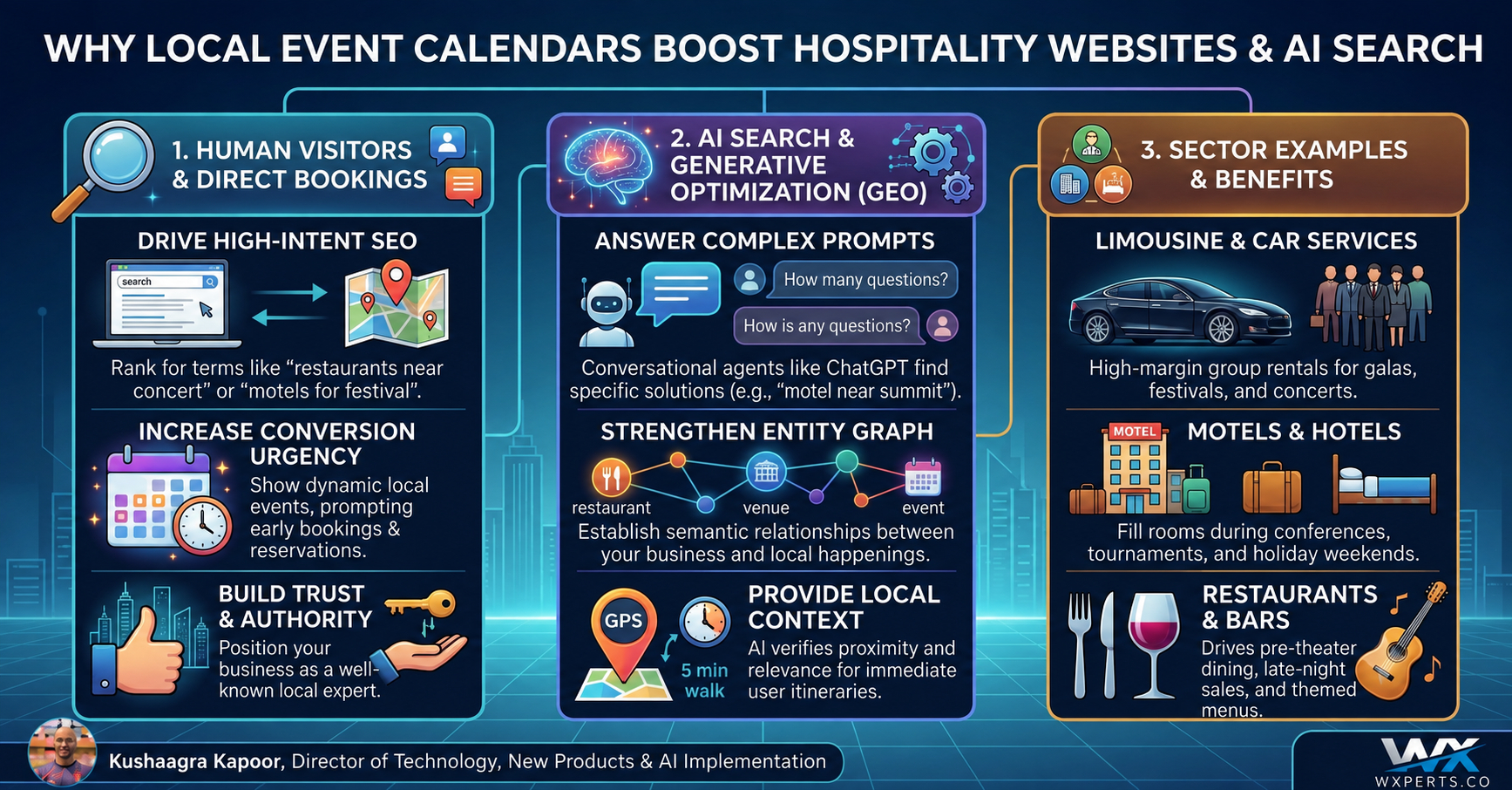
By: Kushaagra Kapoor, Director of Technology, New Products & AI Implementation at Wxperts
For decades, hospitality marketing followed a simple rulebook: build a clean website, load it with generic photos, optimize for keywords like "best restaurant near me" or "hotel in [City]," and run local Google Ads.
At Wxperts, we frequently remind our clients that the modern digital landscape has fundamentally transformed. Today, your primary web audience is no longer just human visitors scrolling through blue links, it is also Large Language Models (LLMs) and conversational AI engines like ChatGPT, Google Gemini, Perplexity, and Apple Intelligence.
Whether you operate a luxury limousine service, a boutique motel, or an independent dining establishment, relying solely on static service pages is no longer enough. To capture high-intent travelers and dominate AI answer engines, your website needs dynamic, machine-readable local context.
The most underutilized secret weapon to achieve this? A strategically curated Local Event Calendar.
1. The Human Side: Driving Direct Traffic & Immediate Conversions
Before diving into AI optimization, let’s address traditional user intent. Travelers, diners, and partygoers plan their activities around experiences, not isolated transit or sleeping quarters.
A. High-Intent Long-Tail SEO
A static restaurant website ranks for a handful of generic keywords. A website featuring a curated event calendar targets long-tail, high-conversion queries, such as:
- "Where to grab pre-theater dinner near [Local Arena]?"
- "Private car service for [Annual City Wine Festival]"
- "Motels near [Regional Marathon Start Line]"
B. Urgency & On-Site Conversions
When potential customers visit your site and see upcoming concerts, conventions, or sports games listed right alongside your services, it creates immediate booking urgency:
- Motels & Hotels: Seeing a major convention tagged on your calendar prompts guests to lock in room rates before availability dries up.
- Restaurants: Highlighting a showtime down the block encourages diners to book an early 5:30 PM seating.
- Limo Services: Event dates act as direct conversion triggers for group transit, hourly chauffeur packages, and airport transfers.
2. The AI & GEO Advantage: Why AI Search Needs Your Event Data
At Wxperts, we specialize in Generative Engine Optimization (GEO) and Answer Engine Optimization (AEO). We build digital ecosystems engineered to speak natively to AI search engines.
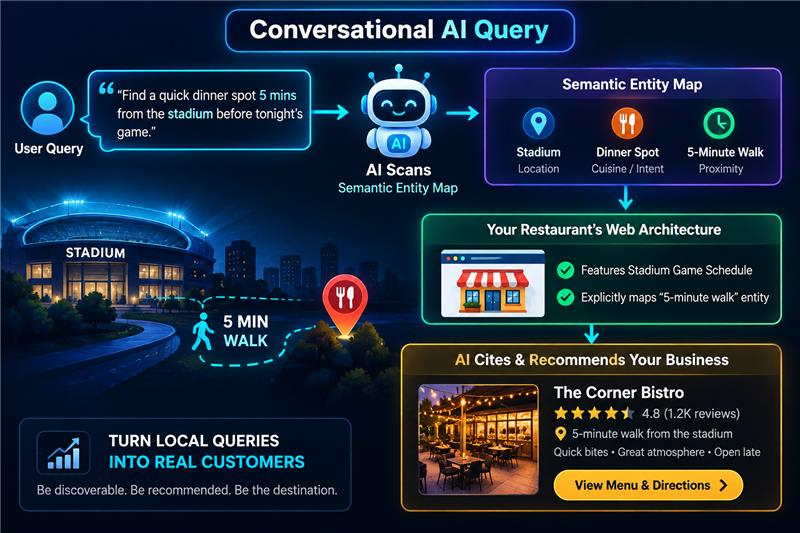
When users ask conversational AI tools for local recommendations, those platforms rely on Entity Relationships and Contextual Mapping rather than plain keyword counts.
An event calendar bridges the gap between your brand and local happenings:
A. Answering Complex Multi-Intent Prompts
Consumers no longer search in short fragments. They prompt AI with complex, conditional requirements:
- "What’s a good motel near the expo center with room availability during the Tech Summit next month?"
- "Book a chauffeur service that handles concert pickups at the outdoor amphitheater."
If your site explicitly connects your business entities to specific event entities, AI models possess high confidence that your business is the precise answer.
B. Building Strong Entity Graphs with NER Tags
AI engines utilize Named Entity Recognition (NER) to parse proper nouns (locations, events, services) and build Knowledge Graphs.
Integrating an event calendar establishes clear semantic links:
These explicit structural linkages signal deep Topical Authority and E-E-A-T (Experience, Expertise, Authoritativeness, and Trustworthiness).
3. Tailored Sector Breakdown
| Industry | Event Calendar Strategy | Wxperts Growth & GEO Impact |
|---|---|---|
| Limousines & Private Transit | Target galas, seasonal wine tours, stadium games, and major airport rush windows. | Captures high-margin group rentals and hourly packages over single-ride requests. |
| Motels & Hotels | Highlight multi-day festivals, conventions, sports tournaments, and regional holidays. | Increases Average Length of Stay (ALOS), fills mid-week room inventory, and prompts early advance bookings. |
| Restaurants & Bars | Feature theater showtimes, pre-game hours, live music, and community parades. | Drives pre-show seatings, late-night bar sales, and targeted event-themed menu offerings. |
Technical Execution: Future-Proofing Your Event Data
To turn a standard calendar into an AI optimization magnet, execution matters. At Wxperts, we recommend implementing the following technical architecture:
- Deploy JSON-LD Event Schema Markup: Don't force AI models to guess details. Hardcode structured schema data declaring the event name, location, dates, and direct booking links.
- Embed Explicit Proximity Signals: Avoid vague phrases like "located nearby." Use machine-readable text like "Located 0.3 miles (a 4-minute walk) from the main entrance of [Venue Name]".
- Build Zero-Bloat, Custom-Coded Components: Slow, plugin-heavy calendar widgets degrade site performance and confuse AI crawlers. Deploy clean, fast-loading, dynamic code structures that render instantly for both human visitors and LLM crawlers.
Transform Your Website into an AI Recommendation Engine
A local event calendar is far more than a simple listing of local dates—it is a strategic asset that bridges real-world hospitality with modern AI search behavior. At Wxperts.co we manage event calendars for your website for events near your business, and optimize it to generate traffic or references from both Generative Engines and Search Engines to bring more customers to your business. Connect with the digital architecture team at Wxperts
Is your website optimized to capture high-intent travelers, or is it invisible to conversational search? Connect with the digital architecture team at Wxperts to see how our custom web engineering and AI Search Accelerator strategies can turn your local online presence into a direct booking engine.
Semantic Keynotes, NER Tags & Structured Data
1. Semantic Keynotes
Primary Topical Clusters:
- Hospitality Digital Strategy: Direct booking engines, guest acquisition, high-intent conversions, Average Length of Stay (ALOS), mid-week room filling, pre-theater seatings, group transit packages.
- Generative Engine Optimization (GEO) & AEO: Conversational search prompts, multi-intent queries, zero-click answers, LLM recommendations, vector search, AI crawlers, dynamic context injection.
- Information Architecture & Technical Execution: JSON-LD Event Schema, structured markup, Named Entity Recognition (NER), Knowledge Graph mapping, E-E-A-T signals, zero-bloat code rendering.
Conceptual Core Messages:
- From Static to Dynamic: Static hospitality websites fail to capture real-time conversational search traffic; event calendars provide real-time, context-rich data.
- Intent Triangulation: Aligning hospitality services (bed, table, ride) with third-party real-world triggers (concert, conference, marathon) creates high-conversion micro-moments.
- Machine-Readable Proximity: Replacing vague marketing phrases (e.g., "in the heart of the city") with explicit metric distance and entity links enables AI agents to verify travel logistics instantly.
2. Named Entity Recognition (NER) Tags
- A. Author & Brand Entities:
- Person / Author: Kushaagra Kapoor
- JobTitle: Director of Technology, New Products and AI Implementation
- Organization / Publisher:Wxperts
- Industry: Web Engineering, Software Development, AI Implementation, Digital Agency
- B. Core Subject Entities (Nouns & Systems):
- Concept / Technology: Generative Engine Optimization (GEO), Answer Engine Optimization (AEO), Large Language Models (LLM), Knowledge Graphs, Schema Markup, JSON-LD, Named Entity Recognition (NER), Vector Search.
- Software / Platforms: ChatGPT, Google Gemini, Perplexity, Apple Intelligence, Google Search.
- C. Industry Sector Entities:
- IndustrySector: Hospitality, Tourism, Transportation & Logistics, Food & Beverage, Lodging.
- BusinessTypes: Limousine Service, Chauffeur Service, Motel, Boutique Hotel, Independent Restaurant, Nightlife Venue.
- D. Contextual Event & Location Entities:
- EventTypes: Concert, Convention, Conference, Regional Festival, Wine Tour, Sports Tournament, Marathon, Theater Show, Gala.
- SpatialRelationships: Proximity, Walking Distance, Transit Radius, Local Context.