
Designing for Humans and LLMs / Generative AI: The New Rules of High-Converting Web Architecture
By: Kushaagra Kapoor, Director of Technology, New Products and AI Implementation . 03-10-2026
Modern web design requires a dual-architecture approach that balances high-converting human user experience with clean, semantic machine-readability. By utilizing explicit HTML5 tagging, JSON-LD structured data, and server-side rendering, brands ensure their content is accurately extracted, summarized, and cited by AI models, LLMs, and Generative Engine crawlers.
For over two decades, web design was defined by a classic tug-of-war: Form vs. Function. Designers fought for sleek visuals, micro-interactions, and immersive aesthetics, while SEOs and conversion specialists demanded fast load times, clear call-to-actions (CTAs), and crawlable text.
Today, a third stakeholder has entered the room: Large Language Models (LLMs) and AI Web Crawlers.
AI-powered search engines, retrieval-augmented generation (RAG) agents, and voice assistants no longer just index keywords, they comprehend structure, intent, and context. If your website is built purely for human eyes but presents a chaotic DOM structure to an LLM, you are effectively invisible to the next generation of web search. Conversely, if you strip away brand identity and visual hierarchy to cater only to machine parsers, your conversion rates will drop.
The solution isn't choosing between visual elegance and AI accessibility. It is adopting a dual-architecture approach: designing high-converting visual UX for human visitors while maintaining clean, semantic machine-readability for AI agents.
1. The Multi-Agent Web: Who Are You Designing For?
Every visitor landing on your URL falls into one of two distinct categories:
The Human Visitor
Driven by emotion, visual cues, social proof, and seamless interaction. They care about typography, brand trust, speed, and intuitive navigation.
The Synthetic Visitor
(LLM Crawlers / RAG Bots): Driven by explicit relationships, clear hierarchy, structured metadata, and semantic HTML. They bypass CSS styling and analyze raw DOM structures, schema markup, and content flow.
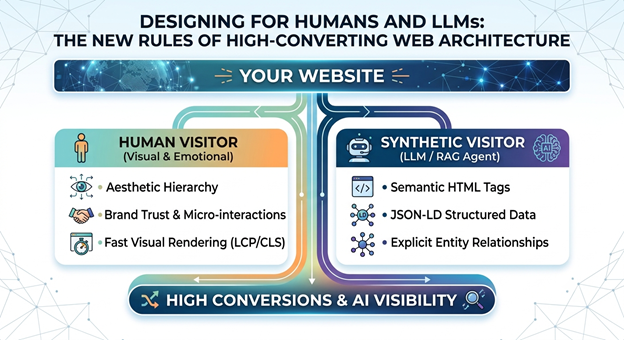
When an AI engine like Perplexity, SearchGPT, or Google SGE generates an answer about your industry, it synthesizes structured content directly from crawlable pages. If your content is buried inside unstructured <div> soup, un-labeled interactive components, or client-side JavaScript that renders empty containers on initial fetch, LLMs will pass you over for a competitor with cleaner code architecture.
2. High-Converting UX vs. Machine Readability: Resolving the Tension
A common misconception is that machine-readable websites must look like plain text documents. In reality, the underlying code architecture that satisfies LLMs is the exact same foundation that powers accessible, high-performing user interfaces.
Here is how key web design elements serve both audiences simultaneously:
| Web Element | Human UX Impact | Machine / LLM Parsing Impact |
|---|---|---|
Header Hierarchy<h1> to <h3>
|
Visual Flow Guides eye flow, creates scannability, lowers bounce rate. |
Context Chunking Establishes logical parent-child relationships for context chunking in vector databases. |
| JSON-LD Schema Markup |
Rich Snippets Enables rich snippets in Search Engine Results Pages (SERPs) (ratings, pricing, FAQs). |
Entity Knowledge Feeds explicit entity data directly to AI agents without guessing. |
Semantic HTML<article>, <aside>
|
Accessibility Improves screen reader accessibility and structural consistency. |
Core Segregation Helps bots instantly segregate core content from navigation headers, sidebars, and footers. |
| Clear Visual CTAs + Form Elements |
Conversion Focus Directs user intent toward conversion points (purchases, sign-ups). |
Agent Automation Standardized form markup and ARIA labels allow AI task automation agents to interact reliably. |
3. Four Core Architectural Rules for Dual-Target Web Design
To build a website that captures high-intent human traffic while remaining top-of-mind for AI search engines, adhere to these structural principles:
1 Adopt Semantic Tagging as a First Principle
Avoid building entire layouts out of generic <div> tags. Use explicit HTML5 tags:
- Use
<main>for primary page content. - Use
<section>with clear heading tags (<h2>) to denote distinct topics. - Use
<nav>,<header>, and<footer>for layout framing. - Wrap repetitive data (like product cards or team profiles) in
<article>tags.
Why it matters: RAG systems slice web pages into text “chunks” before feeding them into LLMs. Clean semantic markup ensures chunks retain their context rather than becoming fragmented noise.
2 Ground Core Information in JSON-LD
Do not rely on the LLM to “figure out” what your product does, what it costs, or who your executive team is. Use explicit JSON-LD structured data.
For example, implementing Product, Organization, FAQPage, and Service schemas gives AI bots structured key-value pairs that they can quote directly in AI summaries with near-100% confidence.
3 Balance Client-Side Interactivity with Server-Driven HTML
Modern JavaScript frameworks (React, Vue, Next.js) enable fluid UI micro-interactions. However, relying entirely on client-side rendering (CSR) where content is injected after the initial HTTP request can lead to incomplete crawling by lower-budget LLM bots.
Best Practice: Use Server-Side Rendering (SSR) or Static Site Generation (SSG) for critical content, ensuring that the raw HTML delivered on the initial fetch contains all readable text and structural markup.
4 Optimize for Conversion Rate Optimization (CRO) Without Dark Patterns
Humans convert when trust is high and cognitive load is low:
- Keep copy direct, value-driven, and active.
- Place social proof (testimonials, client logos, case studies) near primary action buttons.
- Maintain clear contrast ratios and generous whitespace.
When copy is concise and logically ordered for human conversion, it naturally becomes easier for an LLM to digest and summarize accurately.
4. The Path Forward: Building Systems, Not Just Pages
Web architecture is no longer just about rendering pixels on a screen, it is about managing information architecture across human and synthetic interfaces.
By pairing modern visual design with strict semantic discipline, you ensure that:
- Human visitors experience a fast, intuitive, and visually persuasive journey that converts.
- AI models accurately extract, summarize, and cite your brand as an authority in your niche.
At wxpert.co, we specialize in engineering digital platforms that sit at this exact intersection delivering visual excellence for your visitors and clean semantic performance for the modern web ecosystem.
Learn more about our AI-ready services: explore our AI Search Accelerator Package, inspect the AI Content Engine, or contact our technical team today.
Semantic Keynotes & Named Entity Recognition (NER) Tags
DELIVERABLE 1: SEMANTIC KEYNOTES
- Dual-Architecture Necessity: Successful modern web design requires balancing human-centric visual experience with machine-readable structural integrity to satisfy both users and AI crawlers.
- Semantic Integrity for GEO: Utilizing explicit HTML5 tags and logical header hierarchies allows RAG-based systems to accurately “chunk” and index content for Generative Engine Optimization.
- JSON-LD as Trust Currency: Implementing structured data is the most reliable way to feed machine-interpretable entity relationships directly to AI engines, ensuring accurate brand representation in LLM summaries.
- Hybrid Rendering Strategy: Prioritizing Server-Side Rendering (SSR) or Static Site Generation (SSG) ensures critical content remains crawlable for synthetic agents while maintaining fluid UI interactivity.
- Conversion Alignment: High-converting UX practices—such as clear copy and logical content flow—naturally facilitate easier content extraction and summarization by AI models.
DELIVERABLE 2: NAMED ENTITY RECOGNITION (NER) TAGS
- ORGANIZATION & BRANDS:
- wxpert.co
- Perplexity
- SearchGPT
- Google SGE
- PERSON:
- None identified
- PRODUCTS, SERVICES & SOLUTIONS:
- Digital platforms
- Custom Coded Websites
- AI Content Engine
- TECHNICAL SPECIFICATIONS & CODE ENTITIES:
- DOM structure
- JSON-LD Schema Markup
- HTML5
- STRATEGIC & FUNCTIONAL CONCEPTS:
- Form vs. Function
- UX
- Conversions
- Retrieval-augmented generation (RAG)
- Semantic HTML
- Conversion Rate Optimization (CRO)
- Dark Patterns
- Semantic Tagging
- INFRASTRUCTURE & SECURITY ENTITIES:
- Vector databases
- CONTACT, CHANNELS & GEOGRAPHIC DATA:
- None identified