
Closing the Off-Site AI Entity Loop: Synchronizing Google, Apple, and Bing With Your Website Schema
By: Kushaagra Kapoor, Director of Technology, New Products and AI Implementation • Published: November 28, 2026 • 5 min read • Category: Answer Engine Optimization (AEO) & Multi-Platform Entity Sync
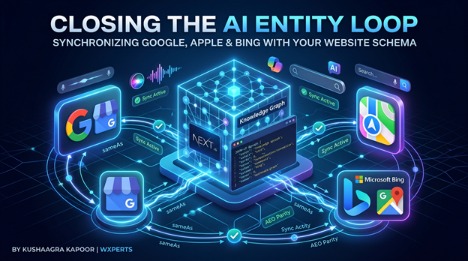
Modern AI answer engines do not rely on your website in isolation. Before citing or recommending a business, Large Language Models (LLMs) and voice assistants cross-reference your site's structured schema against high-authority third-party knowledge graphs: Google Business Profile, Apple Business, and Bing Places for Business. When profiles are unclaimed or have conflicting hours, phone numbers, or addresses, AI engines register entity ambiguity and recommend verified competitors instead. Closing the AI entity loop requires establishing your custom Next.js website as the canonical source of truth and explicitly hard-coding verified profile URLs into your JSON-LD @graph via sameAs schema properties.
Most businesses treat their website and their third-party directory profiles as separate marketing channels. In traditional search, that disconnect caused minor inconvenience. In AI-driven search, it causes invisibility.
When a prospective customer asks Google Gemini, Apple Siri, ChatGPT, or Microsoft Copilot for a recommendation, the answer engine does not take your website at face value. Before citing or recommending a business, Large Language Models (LLMs) execute a cross-platform verification step. They compare the structured data on your domain against external, high-authority knowledge graphs, specifically Google Business Profile, Apple Business, and Bing Places for Business.
If your website declares one set of business hours, phone numbers, or service descriptions while your off-site profiles display outdated information, or worse, remain unclaimed, AI engines register an entity conflict and skip your business in favor of a verified competitor.
The Three Ecosystems Powering AI Discovery
Relying solely on a Google listing leaves massive blind spots across modern operating systems and AI assistants:
- Google Business Profile: Feeds Google Search, Google Maps, and Google Gemini local and commercial recommendations.
- Apple Business: Powers Apple Maps, Siri voice queries, Safari Spotlight suggestions, and iOS system-level business cards across hundreds of millions of devices.
- Bing Places for Business: Supplies entity verification for Microsoft Copilot, Edge browser answers, Windows Search, and third-party AI engines that index Microsoft’s search graph.
Across our audits of over 1,100 small business websites, we routinely find the same pattern: a business has a partially configured Google profile, an unclaimed or completely missing Apple Business listing, and an outdated Bing record pulled automatically from an old data aggregator years ago.
How On-Site Schema and Off-Site Profiles Reinforce Each Other
High-performing Answer Engine Optimization (AEO) and Generative Engine Optimization (GEO) require a closed verification loop between your website architecture and external platforms.
On a custom-coded Next.js site, connected JSON-LD @graph markup tells crawlers exactly who you are, what you offer, and how your business entities relate. However, on-site schema is still a first-party claim. External profiles provide third-party corroboration.
The Three Critical Verification Layers for AI Search
To secure your place in AI answers, we need to treat local SEO as an interlocking trust loop. When we optimize your business, we build and maintain three distinct layers that verify your identity to search crawlers:
1. Next.js JSON-LD @graph (Your Canonical Data)
This acts as the single source of truth, hard-coded directly into your website. It establishes your official name, address, phone, URL (NAP+U), specific services, and structured relationships in a format machines can easily parse without rendering overhead.
2. Google, Apple & Bing Profiles (Third-Party Corroboration)
These ecosystems serve as the heavily trusted anchors that AI assistants (like Siri, Gemini, and Copilot) query to prove your business actually exists in the real world, checking for live attributes like store hours, locations, and photos.
3. Connected sameAs Schema Linking (The Machine Trust Bridge)
This is the final connecting tissue. We edit your website’s Organization or LocalBusiness data node to explicitly name your verified Google, Apple, and Bing profile URLs using the sameAs schema property. This tells AI engines, “This website and those specific external business profiles are one and the exact same brand.”
When your Next.js schema explicitly references your verified Google, Apple, and Bing URLs inside a sameAs array, and those three platforms reflect the exact same NAP+U data, AI models resolve your brand as a single, high-confidence entity.
The Silent Threat of Entity Drift
Claiming your profiles once does not solve the problem permanently. Business directories constantly ingest third-party data feeds, user-suggested edits, and automated scraping updates. Over time, this creates entity drift:
- Holiday or seasonal hour mismatches: Hours change on your website, while Siri and Apple Maps continue reporting your business as closed to potential customers.
- Aggregator overwrites: An automated aggregator overwrites a tracking phone number on Bing, breaking NAP+U parity with your JSON-LD markup.
- Duplicate listings: Duplicate or unverified listings split your citation authority across multiple fragmented records.
Maintaining AI citation readiness requires treating external profiles as live extensions of your website’s data layer, not static listings you set and forget.
Lock In Your Cross-Platform Entity Parity
To eliminate off-site data conflicts without forcing business owners to navigate three separate verification portals, Wxperts has introduced the AI Entity & Knowledge Graph Sync service:
- Turnkey Setup & Verification ($299 One-Time): We execute a complete off-site entity audit, handle Google Business Profile claiming and verification, complete Apple Business brand and location registration, import and align Bing Places, and wire your verified profile URLs directly into your Next.js website’s JSON-LD
sameAsschema. - Annual Entity Sync Retainer ($200 / Year): We provide continuous drift monitoring, ongoing Google Business Profile updates, quarterly Apple Business syncs (including holiday hours), and an annual AEO entity parity check powered by the proprietary Wxperts AEO Audit Engine. No hidden surprises, one straightforward annual fee, while you retain 100% ownership of every account.
To verify your business across Google, Apple, and Bing and connect your off-site profiles directly to your website’s AI architecture, explore AI Entity & Knowledge Graph Sync on wxperts.co or call our team at 888-487-3122.
Semantic Keynotes & Named Entity Recognition (NER) Tags
1. Descriptive Semantic Keynotes
- Off-Site Entity Loop: The continuous verification framework that aligns a website's on-site schema with authoritative external Knowledge Graph anchors (Google, Apple, Bing).
- sameAs Schema Linking: JSON-LD schema properties that point AI models and search crawlers to authoritative external directory URIs to prove entity ownership.
- Entity Drift Prevention: Continuous monitoring that defends against aggregator overwrites, user-suggested edits, and seasonal hour mismatches across external platforms.
- Three-Pillar AEO Suite: Wxperts' interconnected offering including the AI Search Accelerator ($350/yr), AI Content Engine ($100/mo), and AI Entity Sync ($299 setup / $200/yr retainer).
2. Named Entity Recognition (NER) Tags
- ORGANIZATION: Wxperts Inc. | Wxperts | Kushaagra Kapoor
- ECOSYSTEMS & DIRECTORIES: Google Business Profile | Apple Business | Apple Maps | Bing Places for Business
- AI ENGINES & ASSISTANTS: Google Gemini | Apple Siri | ChatGPT | Microsoft Copilot | Safari Spotlight | Windows Search
- OFFERINGS & PRICING: AI Entity & Knowledge Graph Sync ($299 one-time / $200/year retainer) | The AI Search Accelerator Package ($350/year) | AI Content Engine ($100/month per posting)
- TECHNICAL STANDARDS: JSON-LD @graph | sameAs Schema | NAP+U Parity | Answer Engine Optimization (AEO) | Generative Engine Optimization (GEO)